Editing and Placements
Part of Managing recurring UGC production
Maintaining variety in a monthly UGC content package
Plan a monthly UGC mix by buyer question, evidence and product variant while separating concepts from exports.
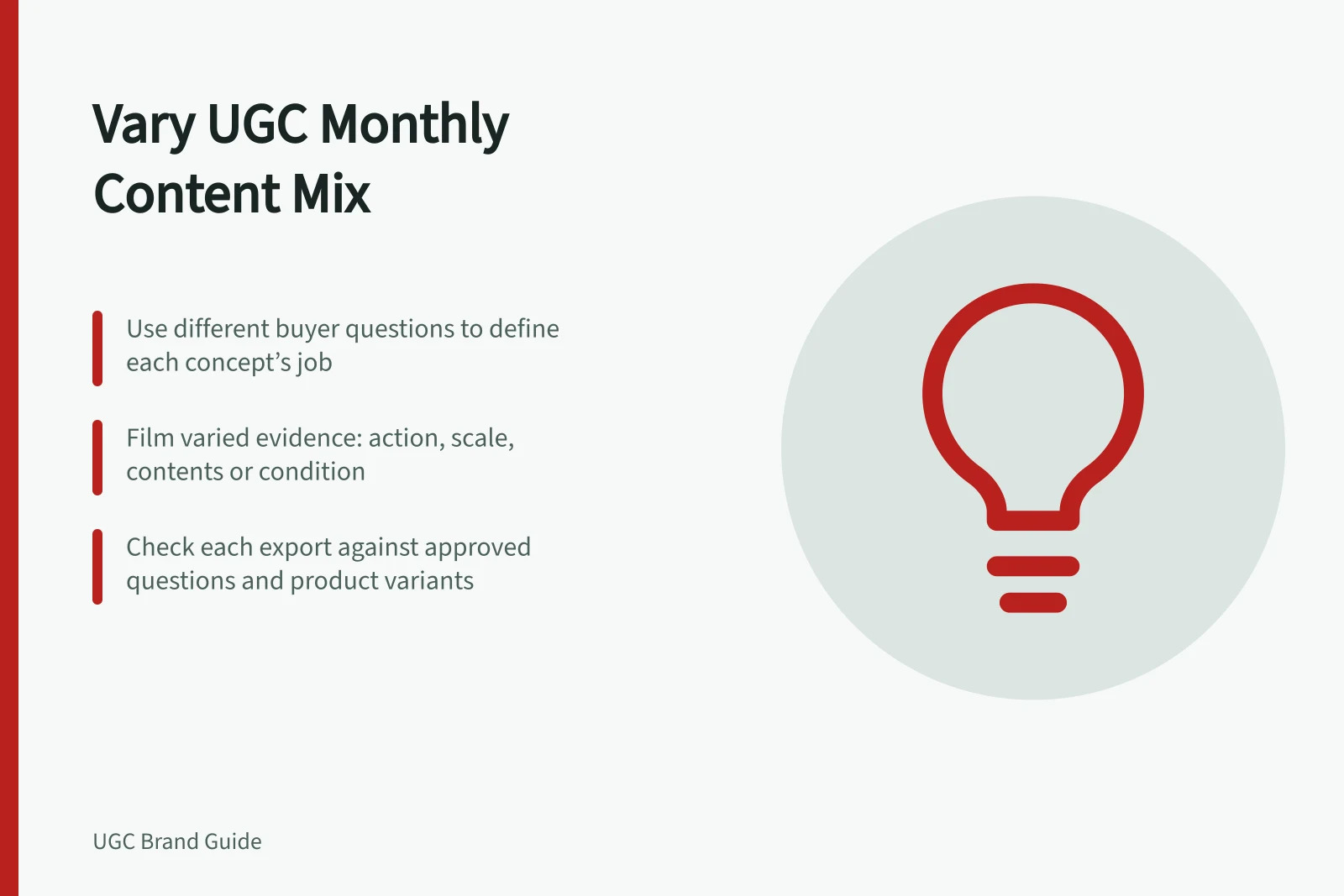
Keep a monthly UGC package varied by giving each new concept a different buyer question or viewing job. Change the evidence, setting or creator when that helps the answer. Several openings cut from one demonstration may be useful versions, but they are not automatically several distinct concepts.
Check the mix before filming
List each proposed concept, the product variant, its central question and what viewers will see. Count finished exports separately. If two concepts answer the same question with the same action, decide whether they are deliberate variants or whether one should cover a gap.
For a hypothetical storage product, a month might include an opening-and-closing demonstration, a scale view on a shelf, a look at box contents and one genuine use account. These are possible jobs, not a prescribed package or claims about a real product. Check the actual item before briefing them.
| Dimension | Reason to vary it | Approval check |
|---|---|---|
| Buyer question | Address another uncertainty | Does the footage answer it? |
| Product variant | Show a meaningful model difference | Is the filmed variant clear? |
| Evidence | Show action, scale, contents or a condition | Is the result visible and qualified? |
| Creator or setting | Explain a different use situation | Is any personal account genuine? |
| Export | Fit an agreed placement | Is it a version of an existing concept? |
Do not force every dimension to change. A new setting adds little if it obscures the product action.
Give each asset a clear job
A mix might include a direct demonstration, a detail explanation and a specific use situation. Check whether the page or campaign needs each one. Exact product facts may be clearer in ordinary copy than in another video. Judge the package by the questions it answers, not a target number of camera angles.
Keep claim limits with each concept. Showing one object fitting one product variant does not establish that every similar object will fit. The ACCC can require businesses to back up claims they make about their products or services.
Key regulatory considerations for UGC content in Australia
- ACCC guidelines on claims
- Businesses must be able to back up claims about products or services
- Online reviews guidance
- Commissioned reviews must not mislead consumers into thinking they are independent
- IP agreements for commercial arrangements
- Formal agreements required for commissioned UGC to avoid infringement
Brief different approaches accurately
Give creators the same verified product information and context, then assign distinct questions and necessary visual evidence. Ask what each can truthfully say from their own use. Do not assign identical first-person endorsements or present a commissioned demonstration as an independent customer review.
If the package includes alternate openings or crops, identify their shared source concept and separate exports. Review each finished cut: a new opening can change what the following footage appears to promise. Check the agreement for the proposed edits and uses of each file.
Choose the next gaps
Compare approved assets with the planned questions. Note repeated scenes, missing answers and product changes that make an older concept less useful. Use that record to choose the next month’s jobs. Treat variety as a planning choice unless a separate evaluation establishes a performance result.