Editing and Placements
Part of UGC for ecommerce product pages
Keeping customer testimonials separate from paid creator demonstrations
Present genuine customer experiences and commissioned creator demonstrations clearly on an Australian product page.
On a product page, present a customer testimonial as that person's account of using the product and a paid creator demonstration as commissioned product media. Do not present commissioned content as an independent customer review.
A paid creator can have a genuine experience; payment does not make their account false. It changes the context shoppers need to understand.
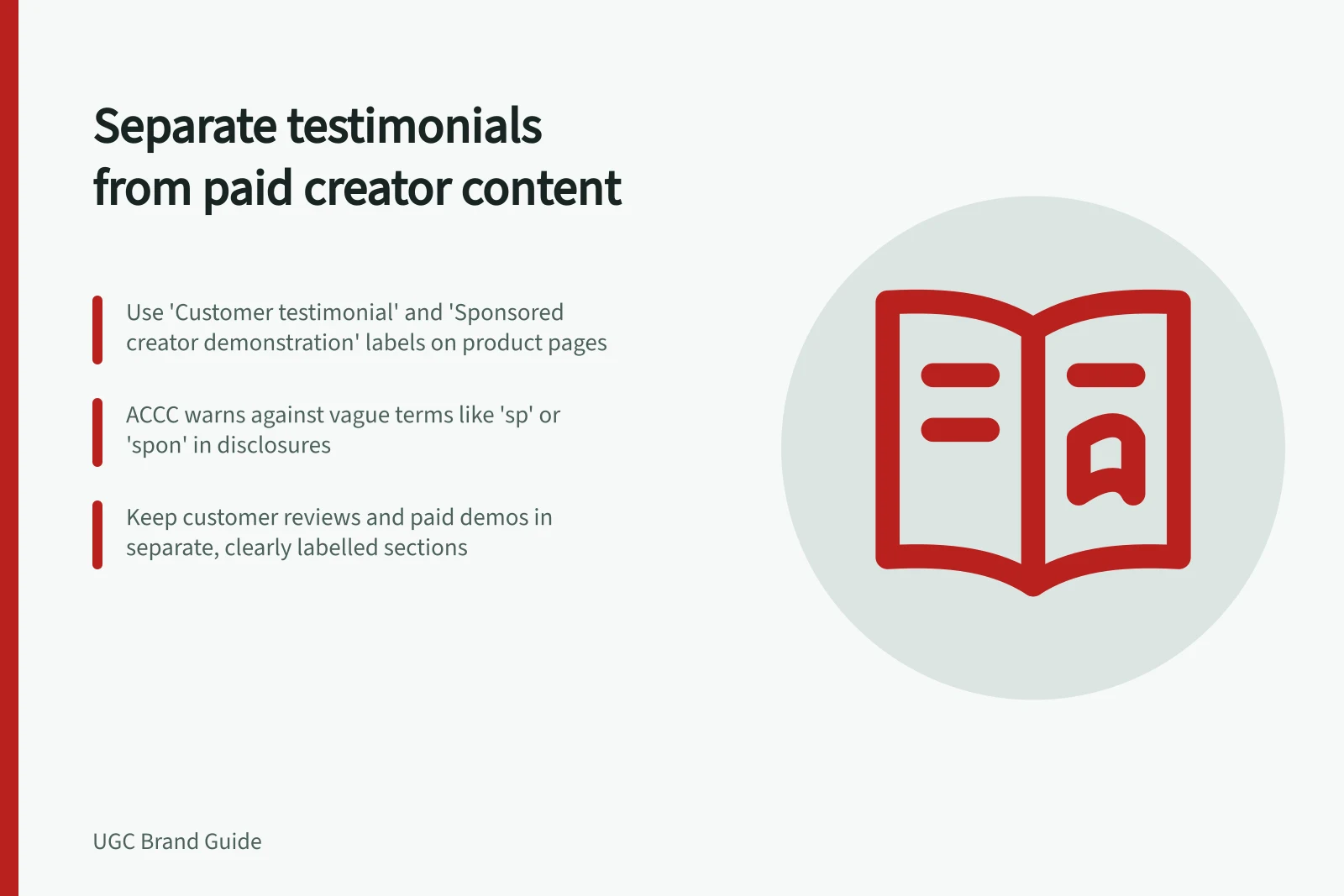
Use distinct, nearby labels: for example, “Customer testimonial” for a customer account and “Sponsored creator demonstration” for commissioned media. Make the sponsored label visible without requiring shoppers to open or expand the asset.
Give each asset an honest role
A testimonial should reflect the reviewer's genuine opinion and preserve any limitation that matters to its meaning.
A creator demonstration can show how a product opens, fits or works under filmed conditions. If the creator speaks about personal experience, the account must reflect what they actually did.
| Asset | Suitable presentation | Check before display |
|---|---|---|
| Customer review | In a review area with its genuine context | Did the person use the product, and has the account been edited fairly? |
| Incentivised customer review | In the review area with the incentive stated plainly | Is the incentive accurately described? |
| Commissioned creator demonstration | As clearly identified commissioned product media | Does it show the listed product without implying an independent customer verdict? |
Use a label that makes the commercial relationship clear. The ACCC has identified vague terms such as “sp” and “spon” as confusing, and found that some disclosures were formatted to hide them or make them difficult to notice.
The Australian Consumer Law requires businesses not to mislead or deceive consumers. It applies to influencers engaging in trade or commerce, as well as brands and marketers using influencers to advertise online.
The ACCC’s “Online reviews for product and services” guidance covers businesses’ online-review responsibilities. Its “Social media promotions” guidance covers how consumer law operates, including avoiding false or misleading claims.
In its 7 December 2023 update, the ACCC said 81 per cent of the 118 influencers reviewed had posts raising concerns under the Australian Consumer Law for potentially misleading advertising.
The ACCC provides general guidance on online reviews, accepts reports about fake or misleading reviews and review manipulation, and may investigate if a business misleads people in relation to online reviews.
If a customer received an incentive, identify it plainly and describe the arrangement accurately. A generic label cannot cure a misleading overall impression.
ACCC Findings on Influencer Advertising Compliance
- Percentage of influencers with concerns
- 81%
- Number of influencers reviewed
- 118
- Applicable law
- Australian Consumer Law
Keep the origins clear behind the page
For each asset, record who supplied it, what product and variant they used, whether they bought or received it, any payment or incentive, material edits and the approved version. Keep product-page display approval with the asset record. Receiving a file does not, by itself, show that its account is genuine or that the proposed use is authorised.
Record whether the asset is a customer testimonial or a paid creator demonstration, and match that record to the label shown on the page.
Keep review moderation separate from creator-asset approval: a review policy can address spam and misleading submissions, while selecting only favourable genuine reviews or removing genuine negative ones may distort the review area. A commissioned clip can be edited for clarity, provided its label and any first-person account remain accurate.
Check how both appear together
A paid demonstration beside a star rating can look like part of the review record, especially on a phone when a section heading has scrolled away. Preview the page and check what a shopper could infer about each speaker's relationship to the brand. Put a clear explanation close to the asset where that relationship matters.
Keep customer testimonials and ratings in a clearly headed review area, and paid creator demonstrations in a separate, clearly headed area rather than presenting them as review entries or including them in the review record. If both appear together on the page, keep each asset’s distinct label beside it.
Compare claims in both areas with current product facts. One customer's successful use of a size does not establish performance across every variant. One creator's filmed result does not establish a typical outcome. Keep a material qualification beside the claim it limits; shortening a mixed account must not turn it into unqualified praise.
Use an asset only when its origin is known, experience claims are truthful, commercial context is clear, edits preserve meaning and the proposed page use is authorised. Hold an item while a material point remains unresolved.