Editing and Placements
Part of UGC scripts and spoken delivery
Editing a testimonial without changing its meaning
Edit a testimonial for clarity, but preserve the speaker's actual assessment.
Edit a testimonial for clarity, but preserve the speaker's actual assessment. Removing a hesitation differs from cutting a limitation that would change what a buyer believes.
Compare the original and final impression
Keep the raw take and a transcript. Mark factual statements, personal opinions and conditions such as “for my small desk” or “after a few attempts”.
When shortening, ask whether a viewer of the final clip would understand the same experience. A positive closing line can become misleading if the earlier explanation of a drawback disappears.
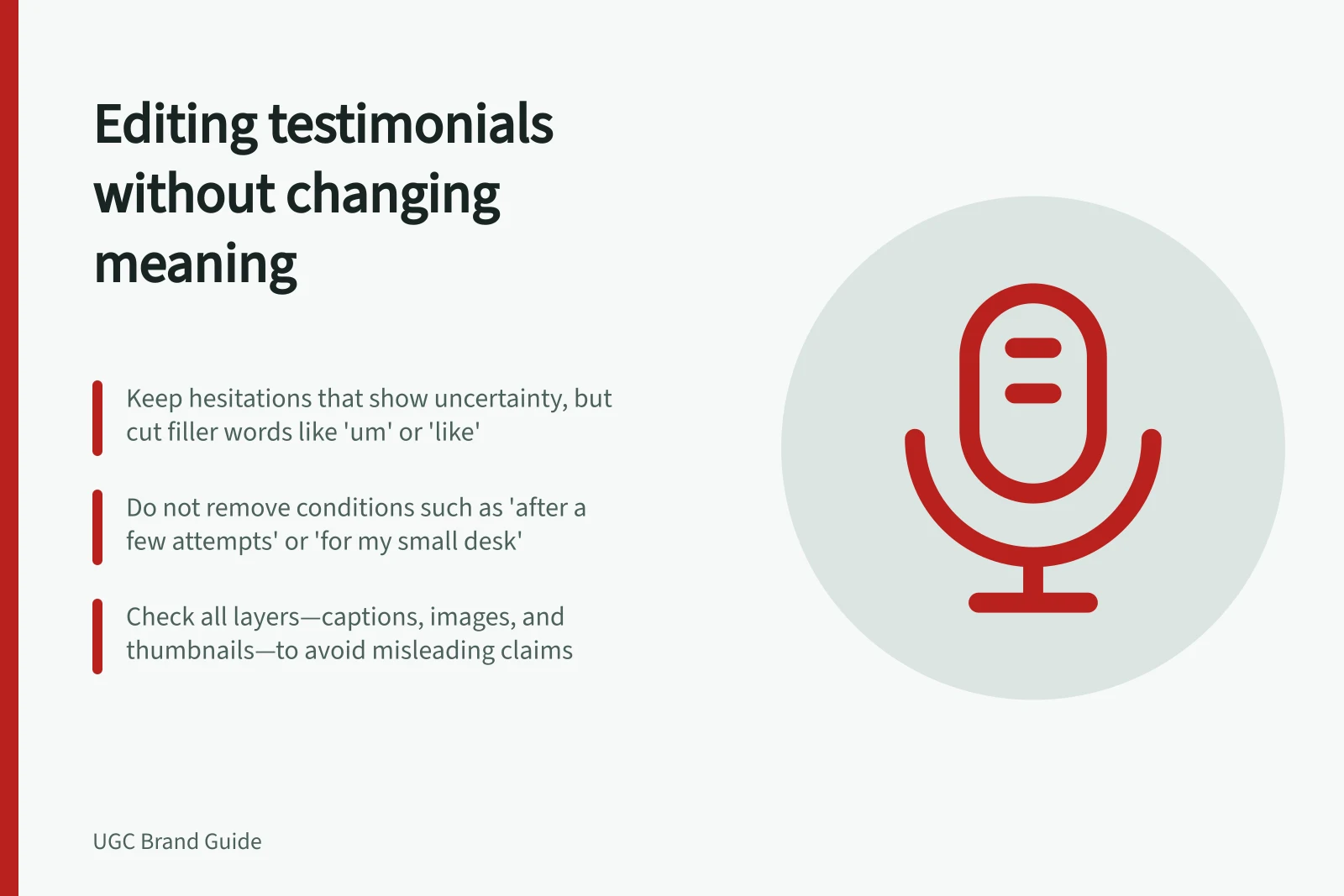
Usually safe to cut dead air, repeated filler or a false start that adds no emphasis. Keep a hesitation if it communicates uncertainty, and do not join separate thoughts into a stronger claim.
Do not remove negations, conditions, limitations, exceptions or words that narrow a claim. Check that a cut does not change its scope, timeframe, certainty, comparison or cause.
Splice only where the remaining words still form a coherent thought the speaker expressed. Preserve sentence order when sequence or timing matters, and keep a qualifier close to the claim it limits.
Do not change tense, pronouns or modal words just to smooth an edit. Changing past tense to present can make an experience sound current, changing “I” to “we” changes who is endorsing the product, and removing “may” can turn possibility into certainty.
Before export, compare the original and final transcripts side by side; mark each clause as fact, opinion, condition or limitation; check every cut and move for a change in meaning; then review the complete clip, captions and overlays together.
Schematic before-and-after example, not a verbatim testimonial: before, a clip includes a drawback and a positive closing, with a condition such as “for my small desk” or “after a few attempts”. After, remove only an empty hesitation; keep the relevant limitation and drawback so the edit does not leave only the praise.
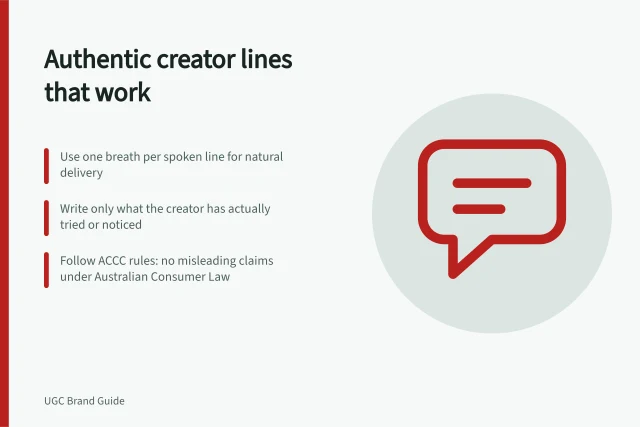
The Australian Consumer Law (ACL), in Schedule 2 to the Competition and Consumer Act 2010 (Cth), applies here. Section 18 prohibits misleading or deceptive conduct in trade or commerce, while section 29 covers false or misleading representations about testimonials.
The ACCC says businesses must not mislead or deceive consumers. This applies to influencers engaging in trade or commerce, as well as brands and marketers using influencers to advertise online; the ACCC can require businesses to back up claims about their products or services.
For influencer-specific context, consult the ACCC publication “Social media influencer testimonials and endorsements”, dated 7 December 2023. The ACCC accepts reports about possible misleading or false claims, may investigate and take compliance or enforcement action, and does not resolve individual disputes or provide legal advice.
Check every layer of the cut
Review voice, captions, text overlays, image sequence and thumbnail together. A caption that says “instant” over footage showing a long setup can mislead even if the creator never spoke the word. If a claim needs context, place it where the claim appears, not in an unrelated note at the end.
Send the final cut to the creator for a meaning check when the agreement calls for approval. Keep the approved version and record substantive changes. If the truthful review is mixed, publish it accurately or choose not to use it; do not manufacture enthusiasm in the edit.
Agree in writing on what may be edited, where the testimonial will appear, whether the creator approves the final cut and how substantive changes will be handled. Check the agreement before making changes or publishing in a new placement.
Keep the raw take, transcript, edit notes, versions, permission and approval together in a project folder. Use clear versioned filenames, such as raw, transcript_v1, cut_v2 and approved_v3, and record who approved which version and when.