Briefs and Shot Lists
UGC scripts and spoken delivery
A UGC script should sound like something the creator could truthfully say while showing the product.
A UGC script should sound like something the creator could truthfully say while showing the product. Start with the buyer's question and the evidence the camera can capture. Write short spoken lines that follow the demonstration, leaving room for the creator's real words and limitations.
Write from observation
Replace “This changed everything” with a specific, verifiable observation: what the creator used, under which conditions and what happened. For a storage organiser, a line might explain how many items fit in the demonstrated compartment, provided the shown model and count are correct. The example is a writing pattern, not a product claim.
Ask the creator which statements reflect their experience. A brand can supply specifications and claim boundaries, but should not require a first-person reaction that has not occurred. The ACCC says claims should be true, accurate and based on reasonable grounds; its influencer sweep found posts raising concerns under the Australian Consumer Law for potentially misleading advertising.
Check each claim before it goes into the script
Mark each script line as personal experience, a product fact or a broader promise about results. Ask what supports the exact wording and whether the evidence matches the product shown. A brand should be able to back up its claims; the ACCC says claims should be true, accurate and based on reasonable grounds.
If a line cannot be supported, remove it or narrow it to what the creator can genuinely show or describe. A qualification can affect the overall impression, not just one sentence. Keep qualifications that affect the meaning; they are not expendable copy.
The ACCC can require businesses to substantiate claims about products or services, and may investigate and take compliance or enforcement action if a business misleads.
Match speech to the shot
Put the key physical action on screen while it is described. If the voiceover says “I set it up in two steps”, show those steps or revise the line. Avoid a quick cut over a difficult action and do not imply a typical outcome from a specially prepared scene. This complements the site's earlier product-demonstration guide, which covers shot planning in more detail.
Read the draft aloud. Cut repeated adjectives, long subordinate clauses and claims that require a disclaimer to be true. Give the creator a clear point to make, then let them use natural phrasing. A short pause for a close-up often explains more than another sentence.
Use the standard consistently
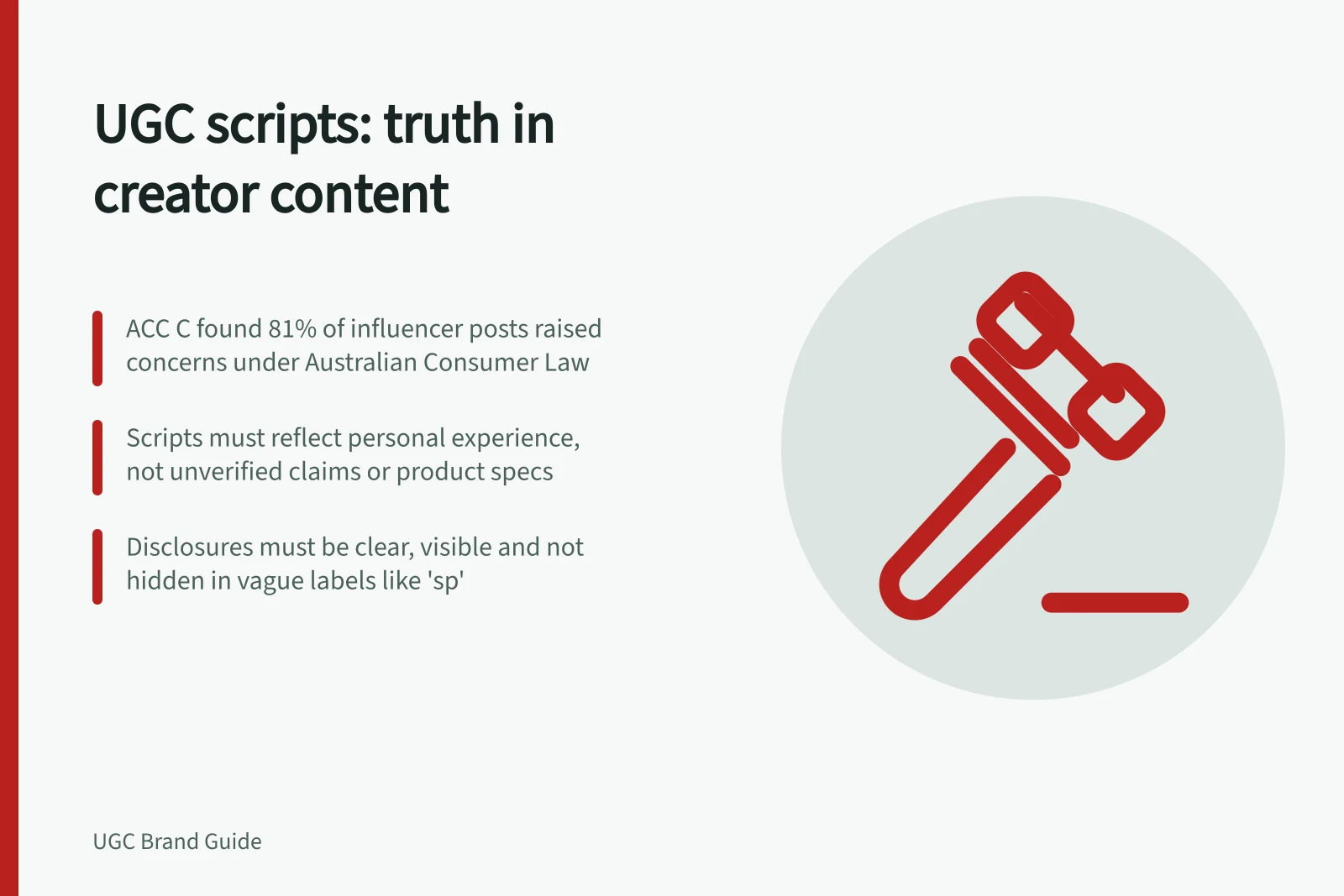
The ACCC’s 7 December 2023 update reported that, of 118 social media influencers reviewed in its sweep, 81 per cent had posts raising concerns under the Australian Consumer Law for potentially misleading advertising. The sweep covered seven sectors; the reported proportions ranged from 96 per cent of fashion influencers reviewed to 73 per cent of gaming and technology influencer posts raising concern.
Those figures describe posts that raised concerns, not a finding that every reviewed post broke the law. They are a reason to check the whole impression of a UGC endorsement: what the creator says, what the viewer can see and whether a commercial relationship is apparent.
ACCC Influencer Sweep Findings (2023)
- 118Total influencers reviewed
- 81%Posts raising concerns under ACL
- 96%Fashion influencers with concerns
- 73%Gaming & tech influencers with concerns
Resolve uncertainty before publication
When a claim or qualification is disputed, pause approval and identify what evidence supports the line and what the viewer would understand from the complete post. If the creator’s experience does not support the proposed wording, revise the line rather than asking them to present it as personal experience.
The ACCC accepts reports about possible misleading or false claims and uses them to inform its education, compliance and enforcement work. It does not resolve individual disputes or provide legal advice, so a script decision should focus on accurate, supportable wording and a clear overall impression.
Process for Approving UGC Scripts
- Identify disputed claims or qualificationsPause approval if wording lacks support from creator’s experience or visible evidence.
- Verify supporting evidenceEnsure product details, shots and voiceover align with what is shown.
- Revise script if neededRemove unsupported claims or rephrase to reflect actual experience.
- Confirm disclosure clarityEnsure commercial relationship is obvious to viewers.
Edit without changing meaning
In review, compare the final cut with the original take. A tighter line is fine if it preserves what the creator meant; splicing out “but it took practice” from “I like it, but it took practice” is not.
Keep a record of approved wording and check captions, on-screen text and product details as well as the voice track. If the creator reports a limitation, decide how to represent it accurately rather than erase it.
Treat the brand relationship as part of the message
A recommendation can sound personal and still be advertising. When a creator receives payment, a gift or another incentive to promote a brand, make the relationship clear in the content that accompanies the recommendation. The ACCC has identified inadequate disclosure of brand relationships as a common issue in its review of influencer posts.
Avoid vague labels such as “sp” or “spon”, and do not format a disclosure so that viewers struggle to notice it. The ACCC reported concerns about confusing language and hidden or hard-to-see disclosures. The script and the post should not leave the audience guessing whether a recommendation is sponsored.
The Australian Consumer Law applies to influencers engaging in trade or commerce, as well as to brands and marketers using influencers to advertise online. So the disclosure decision is not separate from script approval: consider whether the audience can recognise the commercial relationship while hearing or reading the recommendation.
Disclosure Best Practices vs Common Pitfalls
- Best practice: Clear, visible disclosureUse ‘paid partnership’ or ‘sponsored’ in plain language near the start of the post.
- Common pitfall: Vague or hidden disclosureAvoid labels like ‘sp’, ‘spon’ or placing disclosures in small text at the end.
In this guide
- Writing conversational lines a creator can actually sayWrite one idea per spoken line and let the creator adapt the wording to their natural voice.
- Replacing vague praise with observable product detailsVague praise tells a buyer little.
- Editing a testimonial without changing its meaningEdit a testimonial for clarity, but preserve the speaker's actual assessment.
- Keeping a UGC voiceover in sync with the demonstrationA voiceover should describe what the viewer can see, in the order it happens.