Briefs and Shot Lists
Part of UGC scripts and spoken delivery
Writing conversational lines a creator can actually say
Write one idea per spoken line and let the creator adapt the wording to their natural voice.
Write one idea per spoken line and let the creator adapt the wording to their natural voice. A script full of brand slogans may look concise on a page but sound unnatural when spoken over a real product demonstration.
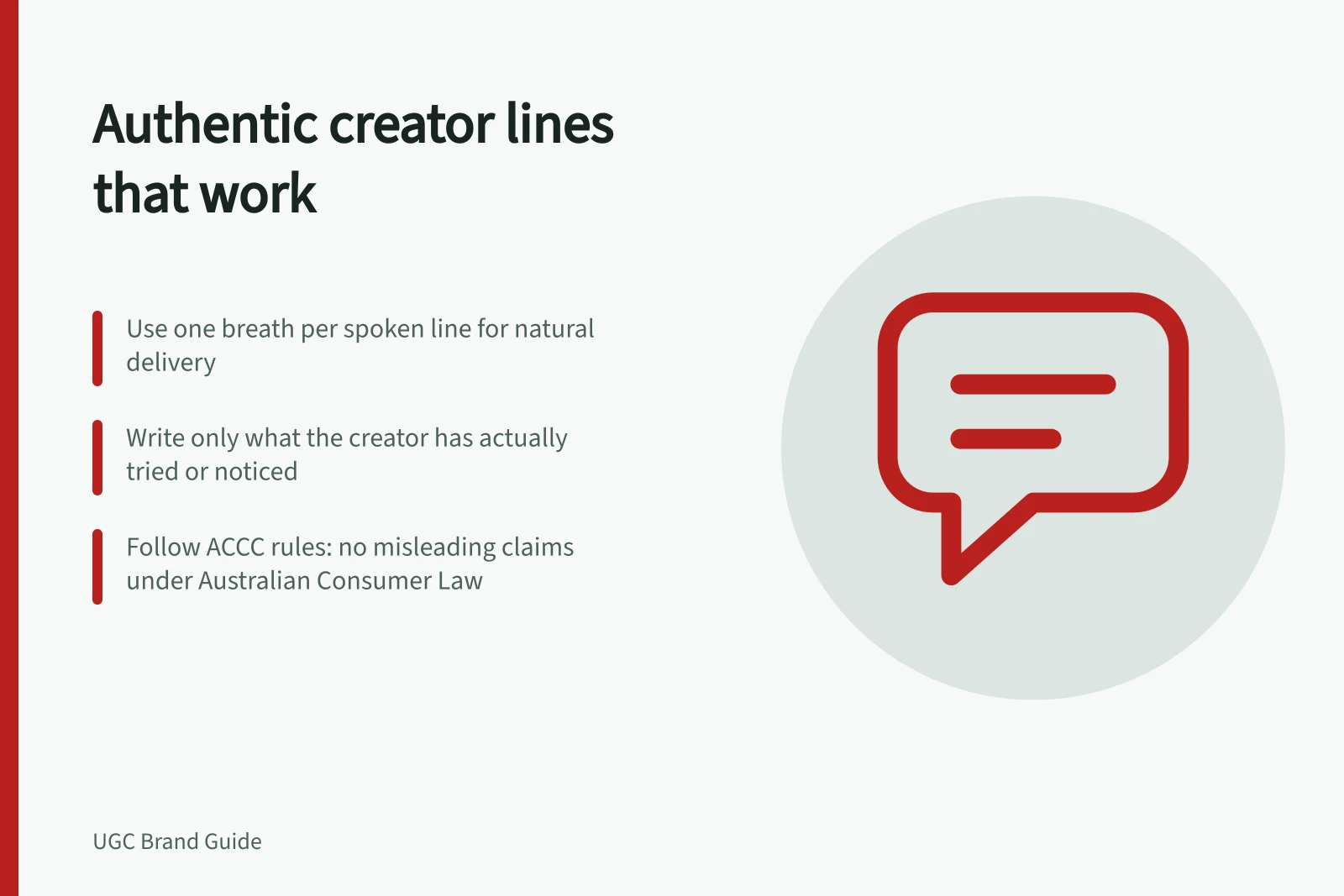
Aim for one breath per line, usually one short clause. If the creator has to rush or take another breath, split the thought and read both lines aloud.
Use contractions and plain words the creator would normally say: “it doesn’t” rather than “it does not”. Read the line aloud and change wording that feels stiff in the mouth.
Start with what the creator can truthfully report
Ask what the creator did with the product and what they noticed; use only those truthful details as raw material for a spoken line.
A line such as “I used the smaller tray for cables” is easier to say and verify than “the ultimate organising solution”. Do not write a first-person endorsement before the creator has tried the item.
A short sequence can begin with “Need to sort cables?” followed by “I used the smaller tray for cables.” Add a result or condition only if the creator can supply it, such as “I noticed [result]” or “For [condition], …”.
Read each sentence aloud at the intended pace. Remove clusters of features that force the speaker to rush, and watch for tongue-twisters, repeated words and awkward sound combinations.
For figures and measurements, write how the creator should say them aloud while keeping the value and unit exact. Put technical specifications in a caption when they are essential but awkward to speak, and check that the caption describes the same model shown.
Mark a pause with a simple cue such as [pause], or mark one word for emphasis. Tell the creator the cue is not spoken, and use it only where the thought naturally turns.
Give boundaries, not a false persona
The brand can identify claims that must be accurate, product names and safety conditions. It should not dictate a reaction or fabricate familiarity.
A line that sounds authentic but describes an experience the creator did not have still creates a misleading impression. If a brand insists on a slogan, ask for an approved plain-language alternative that keeps the same meaning.
Keep a mandatory product name, legal line or safety wording exact. Build a short sentence around it, or give it a separate line, rather than changing or stumbling through the required words.
Under the Australian Consumer Law, businesses must not mislead or deceive consumers. This applies to influencers engaging in trade or commerce, as well as brands and marketers using influencers to advertise online. The ACCC can require businesses to back up claims they make about their products or services.
If required wording cannot be made conversational without changing its meaning, keep it intact and have the creator practise saying it clearly. Do not present it as a personal reaction the creator did not have.
Invite the creator to propose an alternative phrase before filming. Approve meaning, not every filler word. That preserves the buyer's information while making the delivery sound human.
Regulatory facts under Australian Consumer Law
- Legal requirement
- Businesses must not mislead or deceive consumers
- Enforcement body
- Australian Competition and Consumer Commission (ACCC)
- Claim substantiation
- ACCC can require businesses to back up claims about products or services