Briefs and Shot Lists
Product demonstrations in UGC videos
A useful product demonstration shows a buyer what the product is, how it is used and what the result looks like under stated conditions.
A useful product demonstration shows a buyer what the product is, how it is used and what the result looks like under stated conditions. Plan the evidence before the shots. A lively creator video can still mislead if it hides setup, uses a different product size, cuts around a failure or presents a special result as typical.
Choose one buyer question
Start with the viewer's decision: will the item fit a shelf, is assembly difficult, or what does the texture look like in normal light? A short video can answer one of these well; answering all may reduce each to a passing glimpse. Write the buyer question and the proof shot on the brief.
For a storage box, an example brief might specify the exact model, external dimensions, a shot beside a familiar object and footage of it opening on the shelf type the audience uses. This example is illustrative. The product team should supply current specifications and check them against the filmed unit before a creator states a measurement.
Show the sequence without hiding work
Keep the demonstration sequence clear enough to understand the result, and avoid edits that hide a material condition or change what the footage appears to show. For detailed advice on setup steps buyers may misunderstand, see the related guide.
State any conditions or included accessories that materially affect the demonstration.
Brief the creator without scripting a false reaction
Give the creator the approved product facts, safety and setup instructions, and the limits of any claim. Ask them to demonstrate the product in their own words and to flag anything they cannot verify.
Do not prescribe a reaction such as “I was amazed” or ask them to imply long-term use after one session. If the creator has never used the product before, the video can show a first-use experience honestly.
Agree what to do when the product does not behave as expected. The answer may be to reshoot after correcting setup, explain a genuine limitation or leave out a claim that cannot be supported. The brand should not edit out a material limitation while retaining a statement that would then mislead.
Make the brand relationship clear
Decide before filming whether the creator is receiving payment, a gifted product or another incentive, and disclose the relationship clearly in the post carrying the demonstration. Check the disclosure remains visible when the video is republished or adapted; a hidden or hard-to-notice disclosure can leave viewers with the wrong impression.
In its 7 December 2023 update, the ACCC said 81 per cent of the 118 influencers in its sweep had posts raising concerns under the Australian Consumer Law. Inadequate disclosure of brand relationships was the most common issue identified. The ACCC also noted vague labels such as “sp” and “spon”, and disclosures formatted to be hard to notice.
ACCC findings on influencer advertising compliance
- Influencers with disclosure concerns
- 81%
- Most common issue identified
- Inadequate disclosure of brand relationships
- Examples of problematic labels
- "sp", "spon" – often too vague to be effective
Review the final cut as a buyer would
Check the product model and version, visible scale, setup conditions, captions, voiceover and before-and-after framing. Compare every factual claim with the supplied specification or other evidence. Ask someone unfamiliar with the product what they think the video promises. If their interpretation is broader than the verified fact, revise the cut or wording.
Record which asset version was approved and where it will appear. A cropped paid ad can change context, so review that cut too.
Keep claim support accessible
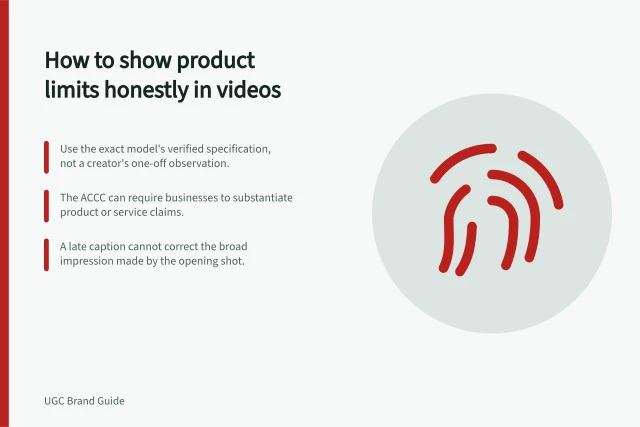
Keep the material that supports each product claim together and easy to retrieve, such as the approved specification for a performance statement. The ACCC says it can require businesses to back up claims about their products or services, so the team approving the demonstration should know where the supporting material is held.
The ACCC accepts reports about possible misleading or false claims and uses them to inform its education, compliance and enforcement work. It does not resolve individual disputes or provide legal advice. For a brand, the practical decision is to check that a demonstration can be defended on its evidence before publication, rather than relying on a later correction.
In this guide
- Showing product scale when viewers cannot touch itShow product scale with verified measurements and a reference that viewers can interpret.
- Filming setup steps that buyers often misunderstandFilm setup in the order a buyer must perform it, especially at the point where a wrong orientation, hidden latch or missing accessory could stop them.
- Demonstrating a product limitation honestlyShow a product limitation where it affects the buying decision, then explain the condition in ordinary language.