Asset Library
Building a record of what each creative test changed
Create a UGC test register that captures exact file changes, campaign conditions, delivery, results and the next decision.
Build a creative-test record around the difference between the control and proposed version. Link that difference to exact files, campaign conditions, results and the next decision. A note saying “tested new UGC” cannot tell the next editor what to repeat or avoid.
Write the change before launch
Give the test an ID and a one-sentence question. For example: “Does showing the product action first change the selected view measure for this campaign?”
Describe both versions in ordinary language. Identify where the change appears in each file. If the new opening also changes captions or duration, list those differences. Do not call it a test of one spoken word.
A compact register can hold one row per test:
| Field | What to enter |
|---|---|
| Question and primary measure | The decision the result should inform |
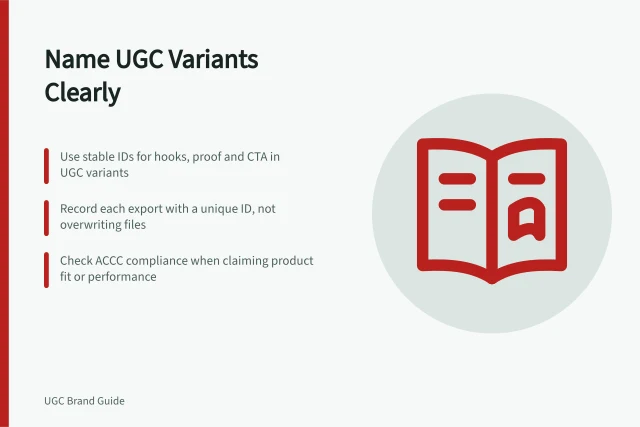
| Control and treatment | Variant IDs, exact export IDs and visible differences |
| Constants and exceptions | Audience, offer, destination, format, bids, budget and dates; note what could not be held steady |
| Approval | Reviewed files, product-claim reviewer and qualifications that must remain |
| Delivery | Campaign and ad IDs, actual dates, exposure and changes during the run |
| Result and next action | Reported measure, limits, decision, owner and date |
This is a proposed working register, not a platform-generated report. A variant label may describe several crops or caption versions; the export ID identifies the file that ran.
Capture context outside the ad account
Platform history can help reconstruct account edits. Google Ads Help includes pages on change history and version history. These records do not explain why a scene was chosen, which source take was used or whether a qualification was approved. Keep those editorial decisions in the local record.
When a setting changes mid-test, note when it changed and which arms it affected. Preserve the original question.
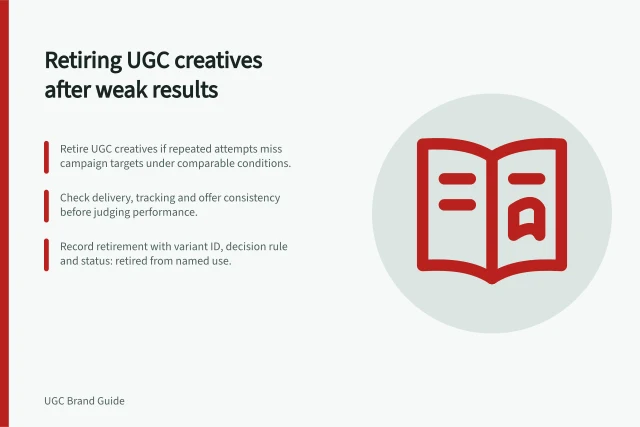
If a correction changes the creative, give the replacement export its own ID and record when it began serving. Separate results before and after the change where reporting permits; otherwise state that the change limits the readout.
Close with a reusable decision
Record what the primary measure showed, whether delivery and tracking supported a conclusion, and what happens next.
A sample closeout might read: “Keep the product-action opening for this audience and format; the selected view measure favoured it, while purchase impact remains unknown.” This is illustrative wording, not a test result.
Attach the report or its export, preserve the tested files and date the decision. If the outcome is inconclusive, record the missing evidence and whether another test is justified.
A colleague should be able to reconstruct what viewers saw, what else changed and why the next creative was commissioned.
![Compare UGC assets across TikTok placements: Record export ID for crop, sound, captions and call to action; Check if TikTok placement includes For You, Profile Feed or Search Feed; Use bounded readout: 'Higher [measure] in [placement] during [dates]'. Comparing the same UGC asset across ad placements](/covers/comparing-the-same-ugc-asset-across-ad-placements-640.webp?v=a31958f1)