Production Budgets
UGC production budgets
Plan a UGC production budget around required assets, comparable quotes, review work, usage permissions and a clear allowance for changes.
Set a UGC production budget around the work the campaign needs: assets to make, approval work and the uses the agreement must cover. Compare quotes against that scope and a total spending ceiling. A low price per video is less useful if the quote excludes an essential edit or intended use.
Here, UGC means content commissioned from a creator for a brand. This budget covers production and delivery; paid media spend is a separate decision.
Set the ceiling before requesting quotes. Build the planning total from supplier fees, direct costs outside those fees and the brand’s own staff time, and keep any allowance for uncertainty inside the ceiling.
Give each asset a job
List the buyer questions the campaign must answer. For each proposed asset, record the product variant, intended placement, essential action or message, and finished file required.
Count distinct concepts and exported versions separately: a second crop of one demonstration may be useful, but it is not a second product story. Keep the count tied to the campaign’s required work.
Build the cost envelope
Budget line / What to allow for
- Preparation
- Product delivery, briefing, scheduling and necessary props or locations
- Production
- Creator time, filming, editing and agreed finished files
- Review
- Internal claim checks, feedback, corrections and approval
- Use
- Permissions for the intended users, channels, period and edits
- Changes
- Additional versions or filming if the agreed work changes
These are planning categories, not standard supplier charges. Ask what each fee includes, what is passed through and what needs a separate quote. Allow for the brand’s own staff time where it falls within the budget.
To calculate the production total, add the selected costs across these categories, direct costs outside supplier fees and the brand’s staff time. Keep paid media outside this total, and treat the uncertainty allowance as uncommitted until a change is approved.
Check the proposed agreement for paid ads, website use, editing, other users and the intended period. A licence permits use on agreed terms; receiving a file does not, by itself, describe every permitted use. If a soundtrack is proposed, establish who will clear it for the planned placements or request a clean version.
Australian UGC Production Cost Factors
- IP Commercialisation
- Brand retains rights unless otherwise agreed
- ACCC Compliance
- Claims must be substantiated; false/misleading claims are prohibited
Compare the required scope
Give every supplier the same countable request: finished cuts, alternate openings, raw footage if needed, delivery dates, feedback rounds and intended uses. Ask each for a base total, optional items, exclusions and a method for pricing changes. Compare amounts on the same GST basis and identify product delivery or other direct costs outside the fee.
Compare the cost of the required scope, not just the headline fee. If one quote includes source footage and another does not, price that requirement into both or leave it out of both comparisons.
To reconcile totals, start with each quote’s base fee, add the priced items required by the common request but missing from that quote, and include direct costs outside the fee. Then compare the adjusted totals on the same GST basis; ask for a revised quote if a required item has no price.
Supplying a brand-ready file and posting from a creator's account are separate tasks unless an offer expressly combines them. Price and list them separately if both are required.
For a repeat order, compare the minimum package commitment with the expected individual orders. Keep the comparison to the total commitment and required scope.
Put the agreement in writing
A contractor arrangement can be agreed in a signed document, email exchange or verbally, but a written agreement gives both sides a record of the terms. It can prevent misunderstandings about the work and cost, and set out how disputes will be handled or the agreement varied or ended.
Record the agreed timeframe, payment amount and timing, and the specifications or materials to be used. A written contract is especially important when the price could threaten the business's finances, a critical completion date applies or the work must meet agreed specifications. Before signing, consider advice from an industry group, lawyer or business adviser.
Set out invoice triggers, payment amounts and due dates so the payment schedule is clear. If payments are staged, tie each stage to an agreed point in the work and check that the scheduled amounts reconcile to the agreed fee.
Budget for the supplier model
If production is a one-off task, weigh the cost of engaging a specialist against the time and money needed to build the skill in-house. For ongoing work, consider the amount of work, training and onboarding required, and whether specialist expertise is needed across several areas. These factors can change the total cost beyond the supplier's quoted fee.
Contractors can be engaged as required and may take less hands-on management, while employees may suit ongoing services or a large project. Employees also bring costs such as holiday pay, superannuation and sick leave; a contractor may instead complete a defined task for a set fee. Compare these factors against the work your campaign actually needs rather than treating either model as automatically cheaper.
Control changes and assess the result
Agree how a missed requirement will be corrected and how a new request will be priced. A new product or message after filming may require a change proposal; whether it needs another shoot depends on the available footage and the agreement. Keep an allowance for uncertainty, and approve any added cost and date change before work proceeds.
Use a written variation approval for any change to the agreed scope. Record the requested change, its added cost and any date impact, then approve it before the supplier proceeds and update the remaining budget ceiling.
At delivery, record what was spent, what files were approved and which uses are covered. Check the product, spoken and on-screen claims, required action and exports against the order. The ACCC says it can require businesses to back up claims about their products or services. A file that cannot be used for its intended purpose should not be counted as a successful budget output.
Keep the approved scope, quote, agreement and any change approvals together so the final spend can be checked against the terms both sides accepted. If a dispute arises, a written record helps establish what was agreed; without one, parties may rely on memory and important terms such as price or work required can be disputed.
In this guide
- Comparing per-video prices with monthly UGC packagesCompare per-video and monthly UGC quotes on matched deliverables, minimum commitment, extras and the number of videos you expect to use.
- Costing raw footage, alternate hooks and reshootsDefine and price UGC raw footage, alternate openings and reshoots with clear outputs, rights, review work and change terms.
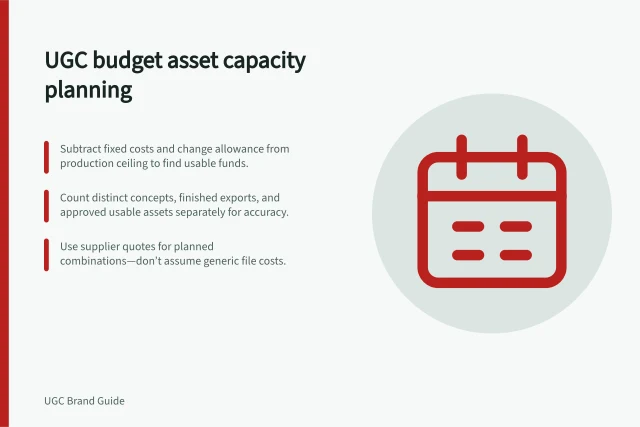
- Deciding how many usable assets a UGC budget can supportEstimate UGC asset capacity by separating fixed costs, distinct concepts, finished exports and files ultimately approved for use.