Licensing
UGC licensing and reuse permissions
Plan UGC rights for organic posts, paid ads, edits and later reuse. Learn what to record before a brand publishes or relaunches a creator asset.
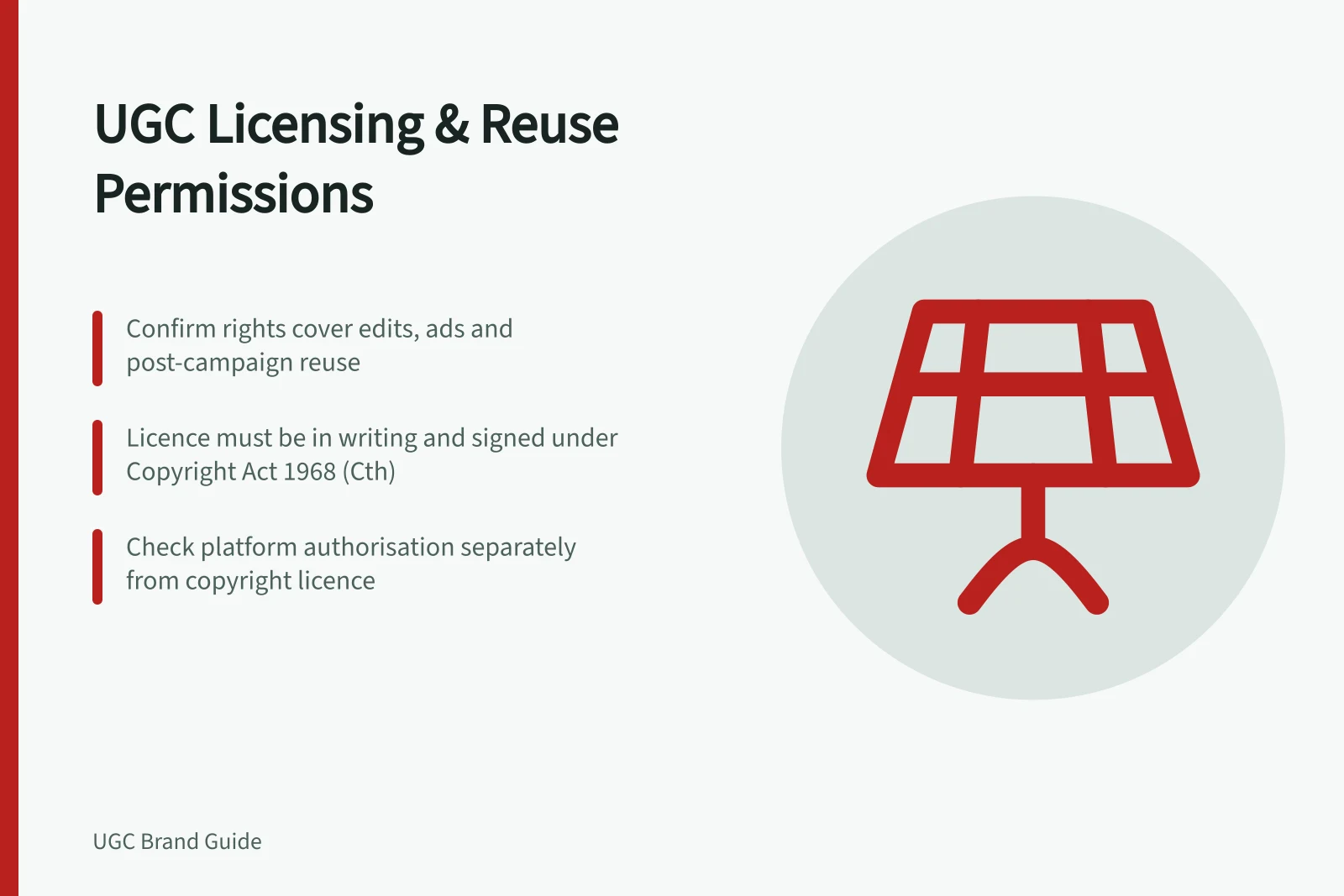
Before a brand publishes or reuses a UGC asset, confirm its rights cover the proposed use. Keep the agreed terms with the approved files. Note whether the permission relied on covers edits, advertising and reuse after the campaign ends.
The Copyright Act 1968 (Cth) is the statutory anchor for copyright ownership, licences and assignment. IP Australia distinguishes a licence, which permits use of IP, from ownership of it.
Key Legal Requirements for UGC Licensing in Australia
- Copyright Act 1968 (Cth)Legal foundation for IP rights and licensing.
- Assignment Must Be In WritingUnder s 196(3), any transfer of copyright must be in writing and signed by the owner.
- IP Australia GuidanceDistinguishes licences from ownership; provides commercialisation pathways.
- ACCC Consumer LawApplies to social media claims; requires substantiation of ad content.
Identify the rights and the files
Ask who made the video and each element in it. A videographer, editor, musician or artist may hold rights the creator cannot grant. Record what is original, what the brand supplied and what has a separate licence.
Record the ownership position stated in the agreement. Identify separate material or terms that may affect the proposed use, and check the relevant agreements rather than inferring ownership from the commissioning arrangement.
Identify the deliverables the agreement covers: the final cut, alternate versions, stills and raw footage if supplied. A grant for one finished video may not cover new edits made from source footage.
Check moral rights and credits separately from copyright ownership. Record the agreed attribution and check the creator's terms before edits or presentation that could affect credit.
Match permission to how the content is collected
Map where content enters the brand's workflow, such as a direct commission, a customer submission or a post found on a social platform. Do this before deciding which permission record applies.
For customer submissions, consent may come from an explicit licence, platform terms, or a hashtag or reply-to-consent flow. Keep the route and its terms identifiable with the asset. A public post or a tag alone does not describe the scope of permission the brand intends to rely on.
Define the permitted use
- Who can use it?Name the brand and any agency, retailer or related business that needs rights. Address onward licensing where relevant.
- Where can it run?Specify organic posts, websites, email, paid ads, platforms and territory as needed.
- What can change?Cover crops, subtitles, shorter cuts, stills and any approval needed for edits that alter the creator's meaning.
- For how long?State the term and distinguish continued display of an existing post from new promotion after the term ends.
- What does the fee cover?Make clear whether production, paid use, extra placements and extensions are included.
A licence permits use within its terms without necessarily transferring ownership. Exclusivity and its scope should be explicit. If an assignment of copyright is intended, state it expressly in the agreement and check the applicable legal requirements.
Under the Copyright Act 1968 (Cth), an assignment must be in writing and signed by or on behalf of the copyright owner (s 196(3)). A licence gives permission within its terms rather than transferring ownership.
Choose the licence structure
An exclusive licence gives one person or business the right to commercialise the licensed material and excludes the owner and others from doing so within the grant. Exclusivity can be limited to a geographical area, a field of application or a class of product, rather than applying to every use.
With a sole licence, one licensee can use the material while the owner may still commercialise some aspects of it. A non-exclusive licence allows more than one person or business to use it, while the owner may also commercialise some aspects. State the intended structure rather than relying on the label alone.
A licence can itself be assigned to someone else, transferring the licensed rights. Licensing terms commonly restrict assignment without the licensor's prior written consent. State whether a brand or agency may transfer the licence and what consent is needed.
Check paid use and embedded material
Agree on paid use before placing the creator's face, voice or post in an ad. Record whether the brand will upload a file or promote the creator's post. Some formats also need platform authorisation.
Check that the licence covers commercial advertising and the intended channels, edits and term. Platform authorisation is a separate step and does not establish rights for other uses.
TikTok, for example, requires authorisation to use another creator's organic post in Spark Ads and allows an authorisation duration to be set. That platform step does not establish rights for other uses.
Review the final ad's claims and images. Australian Consumer Law applies to social media advertising, and a shorter cut can lose a qualification that made the original accurate. Check music and visible artwork separately too.
The ACCC can require businesses to back up claims made on social media and may investigate or take compliance or enforcement action over false or misleading claims. Keep support for an ad claim with the approved version, and check that it still substantiates the claim after edits or cropping.
Keep a usable permission record
Store the agreement, covered files, permitted users and channels, editing scope, territory, term, platform authorisations and third-party clearances under one asset identifier. Keep the evidence of consent and the applicable terms identifiable with that asset. Before reuse, compare the new file, account, platform and dates with that record. Obtain an extension or resolve an unclear term before the new use begins.
Pre-Reuse UGC Permission Checklist
- Agreement stored with assetYes / No
- Permitted users identifiedYes / No
- Territory and channels confirmedYes / No
- Editing scope definedYes / No
- Platform authorisations securedYes / No
- Claims still substantiated after editsYes / No
In this guide
- Distinguishing asset ownership from a usage licenceUnderstand the difference between owning a UGC file, licensing its use and transferring copyright, then record the rights your brand actually needs.
- Agreeing on paid advertising rights for UGCSet paid UGC rights by asset, account, platform, term and edits. Keep creator agreements, platform authorisation and ad claim review aligned.
- Handling music and background artwork in UGCCheck music, artwork and other third-party material inside UGC before reuse. Learn what permission records to request for brand and paid use.
- Renewing a UGC licence before an ad is relaunchedCheck dates, channels, versions, platform authorisation and third-party rights before a previously approved UGC ad runs again.